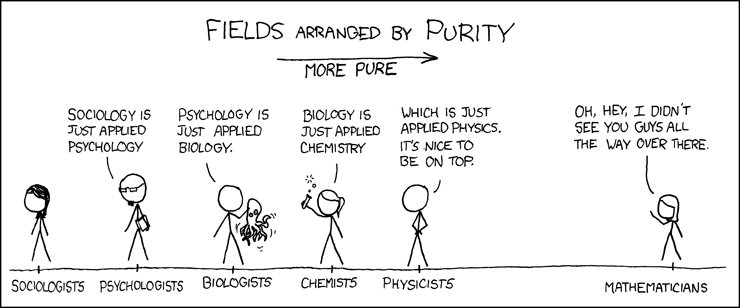
Reading the introduction reminded me that the tension between concrete and abstract in mathematics has been around for centuries and is unlikely to disappear any time soon. It is readily apparent in the academic and workplace math streams with the latter often viewed by students (and some teachers) as a lesser form of mathematics.
 I enjoyed the measurement activity as a fun beginning to embodied mathematics. My final paper/project in EDCP 552 was related to embodied learning with a focus on the link between gestures in spatial reasoning. My husband and I calibrated our body measurements, then I went outside to pace the length of the retaining wall next to our house. My body-based measurement was 27 paces, 1404 inches, or 117 feet in length.

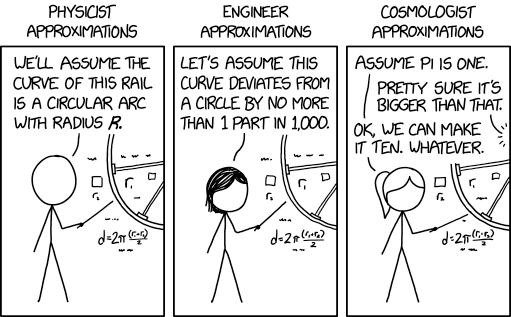
The idea of playing with math seems to be missing in many secondary classrooms, including my own. Likely a combination of pressure to cover all of the material and a significant proportion of students not finding math fun. They would relate to the idea of math as “a complicated but ultimately meaningless game of moving symbols on paper according to algorithmic rules”, but not in the way Bourbaki mathematicians intended. Embodied activities could help students take math a little less seriously and help shift the perspective of math as symbolic manipulation.

Students with an algorithmic understanding of mathematics had a tendency to recreate the graphs using their arms and fingers as if they were drawing on a white board in front of them. They also focused on specific details and numerical values present in the graphs they were give. Students with a deep understanding of mathematics had a tendency to use their arms and bodies to enact the features of the graphs, being the graph. I wonder if Plato and the "enlightened" mathematicians would be horrified by the top students debasing themselves in this way? Though I think it clearly shows that a physical understanding does not mean a lower level of understanding.
It was quite an interesting read and the results made sense to me. Students with strong understanding are able to view and represent the graphs using multiple perspectives. The others were only seeing from one perspective and simply attempted to re-create what they saw. I also really appreciated the tempered suggestion that gestures and embodied learning could make a useful addition to the teacher’s toolkit, but do not nullify other approaches. In my experience, there is a lot of emphasis placed on visual and auditory learning, but kinesthetic learning is often overlooked at the secondary level, especially in courses that are considered more rigorous or academic in nature.
She writes, “an embodied gestural approach to the teaching of graphs and functions would be helpful in offering a multimodal resource for learners to draw on in their studies. That is not to say that current teaching methods using algebra, word problems, tables of values and drawn diagrams ought to be abandoned – quite the contrary. Rather, these more traditional methods ought to be supplemented by elicited large, close-up gestures, especially in the initial stages of teaching mathematical functions." (p. 254)
I wonder, would using gestures as a teaching tool in math help students with an algorithmic understanding, or could it muddy the waters since they don't "experience" math?

I laughed at your initial comic! I have a chemistry degree and everyone always wonders why/how I can teach math...*sigh*. I also teach a great deal of Workplace math and find it to be such a good course with rich, useable concepts; however, the uptake of this among the students and some of the support teachers is nonexistent. Just push them through is the mantra!
ReplyDeleteI agree that geometry is well understood by some students but I am finding that over the years the foundational knowledge is lacking and as it not something that is explicitly taught in grade 9 and up that students are lacking the common language and understanding of simple geometric shapes. Even the typically well-known triangle. So I can see how students would not want to be challenged to show their understanding of geometry as their exposure has been nil in some cases.
As I only teach linear graphing to grade 9s, I do not have the opportunity to introduce non-linear graphing. However, I know of others that have used dance and songs to introduce the various equations and the resulting graphs - often using whole body movements to make the shape of the graph. Or even the Desmos activity that I shared for 550, where you can hear the graph as it goes up and down or stays constant. All of these combined incorporate the various forms of learning and can reinforce one another. I believe we can use any or all of these options in conjunction with each other to inspire learning and encourage a long term memory recall of the concepts. The traditional methods mixed with these embodied options can only amplify one another.
I agree, the Workplace curriculum has so much potential for a fantastic course, but there is a lot of negative perception that has to be overcome. I have a "maybe some day" dream of designing a course with our shop teacher to combine Workplace math with Woodwork.
ReplyDeleteMe too!!!! A long time ago, I TOCed for a Workplace Math teacher that was in the Woodworking Shop. I have had many conversations with our Shop teacher about this. One day, . . .
DeleteI have always thought that the Workplace classes should be taught by the trades teachers. Those areas are just not me and I am not sure I am doing the course (or the students) justice at times! But then I have heard that trades teachers do not do a good job and just do booklets as the students do not give any effort to projects so I am not sure what the answer is.
DeleteThanks for posting such a thought provoking blog post. First of all, I agree with you that manipulatives aren't always helpful. The worst part of grade 8 math were those awful algebra tiles. Some would get it of course but to those who didn't, I think it made the the lessons even more complicated. Second, I completely agree with your statement "the idea of playing with math seems to be missing in many secondary classrooms, including my own. Likely a combination of pressure to cover all of the material and a significant proportion of students not finding math fun." I find that many who are conditioned to suffer the math are not open to other ways of learning. I think you are spot on in your closing statement that traditional methods mixed with these embodied options can only amplify one another. If the students are not open to other ways of doing math due to the many years of conditioning to believe that math is one way, the traditional way, can we blame them? "Just teach math the normal way!" and "Why do I have to learn it many ways, just give me the steps so I know what to do!"
ReplyDeleteI wish algebra tiles were removed from a requirement in the curriculum. I only draw them in Math 9 and never take them out physically. The students find them more work than just learning the area model, which I think is more useful. They are too limiting in their usefulness.
DeleteSorry, the " you" referred to Andrea in "I think you (Andrea) are spot on in your closing statement that traditional methods mixed with these embodied options . . .
ReplyDeleteI think Danielle mentioned it too and it was a comment in the last article!
DeleteWonderful post and discussion! Thanks, Danielle, for the great writing, connections, cartoons and deep thinking about these topics. It's interesting that something like alge tiles, which CAN be helpful in understanding the history of algebra and quadratics, can also be turned into meaningless drudgery when it is required to be taught (without appropriate context). I think that is the same for any kind of activity, embodied or not -- and that can certainly be the case when manipulative use substitutes for deeper understanding rather than enhancing it. The need to integrate embodied and abstract learning is so clear in these examples! I really enjoyed this discussion!
ReplyDelete