Saturday, January 29, 2022

Week 3: Sustainable mathematics in and with the living world outdoors

Wandering around in nature is one of my favourite things to do so I really enjoyed the theme for this week. I like to take my science classes outdoors whenever possible and look forward to finding more reasons to bring math outside as well. The times I have taken math classes outdoors have been an interesting experience as students seem to think the activities are not real math, even when explicitly linked to the content. As we discussed in week one, I find that students in high school have a fairly narrow view of what math is and have some “unlearning” to do before these activities reach their full potential. Perhaps finding the balance mentioned in this week’s introduction might have to start with adding just one small item to the non-traditional side of the fulcrum. 


Learning outdoors also takes more time than traditional classroom learning, but it does feel richer and fuller. Milner spoke of the time it took to choreograph and film Dancing Euclidean Proofs and the way it made him slow down and consider the steps of the proof and the importance of their order. That stood out to me because life feels very rushed at times, especially when I am attempting to cover all the content in upper-level math classes. I wonder how much deeper the learning could be and how many more connections could be made if we had the opportunity to slow down, make interesting observations, and experience the concepts in multiple ways.


For my outdoor excursion, I went to a small park near my house. As I was observing and sketching I noted that many of the human-made things had straight lines and right angles while the living beings had curved lines. Even the straight lines in nature like the Magpie’s tail feathers, Ponderosa Pine needles, and stalks of grass are all slightly curved. In my reading for the week, Doolittle notes the same, “To paraphrase Leopold Kronecker, the Creator gave us shapes;

straight lines are the work of man” (p.104). 


Doolittle’s chapter explored the ideas and limitations of our familiar grid systems. He notes their “common use in the dominant culture leads to familiarity and comfort. The main questions we should face are to what extent those sensations are illusory, and how we can reflect reality better in our thinking” (p. 102). This made me laugh even though it was not intended to be humorous. I was reminded of my dad always claiming he and other men navigate by grid rather than navigating by landmarks like women. He was implying his method was superior, yet he was the one who always got lost. As teenagers, my siblings and I left him in the woods after a disagreement about directions and we arrived home hours before he did. 


Doolittle claims that “Euclidean geometry is often promoted for its practical value; the failures of the grid show that its practical value is limited to small, uniform regions of space-time” (p. 108). The limitations of Euclidean geometry can be found in real life with examples such as map projections, correction lines, and roads following geographical features. You can see this failure in the photo of my sketch of the sign. The camera was not directly above the sketch and parallel. As a result, my once straight lines and right angles are distorted.  


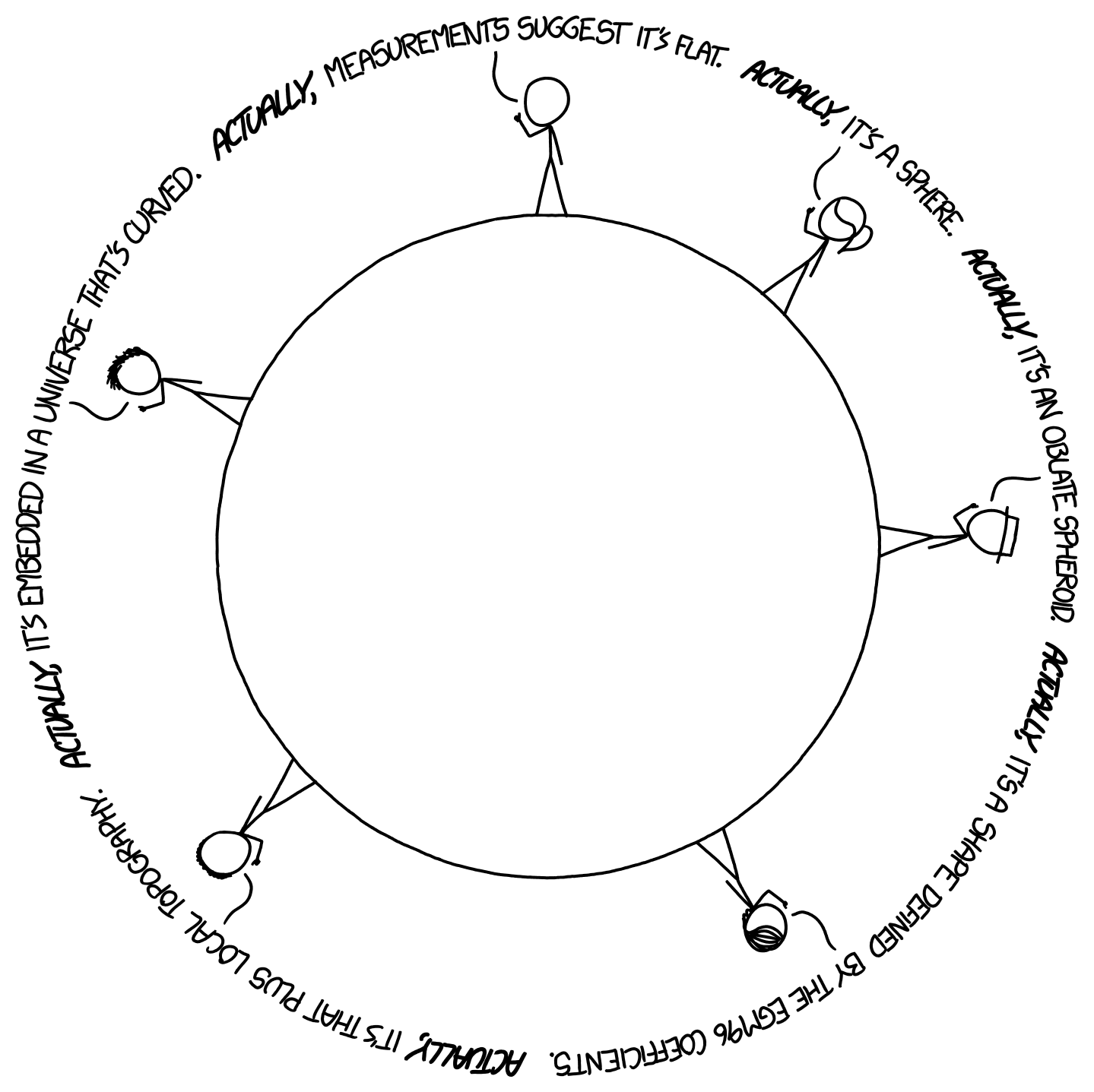
He also raises the issues of perspective and frames of reference, arguing that different systems and frames of reference may be equally valid since they are simply a way for us to impose our own set of rules on a reality that is independent of those same rules. The limitations of Euclidean geometry within mathematics also increase as things get more complex. Once the shapes you are interested in are no longer rectangular it becomes much easier to describe them with cylindrical or spherical coordinates. I rarely used Cartesian coordinates beyond the first year of university.  


It was interesting to note that the playground was updated last summer and all of the new equipment was curved. I think it would be interesting to incorporate the playground equipment into lessons involving the unit circle. The swings alone could be used to teach arc lengths, radians, positive and negative angles, co-terminal angles, and reference angles. You could easily move into sinusoidal functions as well. I have also seen incredible art work created with Desmos, you could even challenge students to sketch what they see using mathematical functions.


Saturday, January 22, 2022

Week Two - Multisensory Math

Activities
 

There are a few math activities that I do with candies and one starts similar to the video. 

  1. Take a box of Smarties and sort them by colour.

  2. Create a bar graph to represent the frequency of each colour in the box of candy. *Use a fairly large scale for the graph

  3.  Calculate the fraction of each colour.

  4. Calculate the percentage of each colour.

  5. Cut out the “bars” of your graph and tape them end to end to make a circle.

  6. Trace the circle and use your bar graph to make a pie chart.

  7. Use the percentages in step 4 and the 360 degrees of a circle to calculate the angle of each piece of the pie.

  8. Use a protractor to measure the angles and compare with your results in step 6.

  9. Calculate the fraction of each piece of the pie and compare with your results in step 3.

  10. Explain any differences in the angles and/or fractions.

  11. Compare your results to the rest of the class.


I do not have a printer so I used a ruler and compass to make my hexaflexagon based on the template provided. The paper was 28cm long so I marked off 5.6cm intervals and used a compass to find the apex of my equilateral triangles. I looked at the fidget spinner template to see where to colour each side, then folded my paper according to the instructions. It took a few tries to get comfortable flipping/folding my hexaflexagon, but it worked as intended.


I did not have the ingredients for a Flex Mex burrito, but I did have tortillas so I rummaged around the kitchen and opted for an homage to a tuna melt instead. The trickiest part was folding the cheese into the middle as it was the opposite of how I had practiced with the paper version. Also, the tortillas were a little on the dry side so they cracked a bit during the folding process. I wasn’t crazy about the tuna leakage, but I do think this would enthrall and astound my nieces and nephews and could alleviate some picky eating!


I did not have any bagels either, so I used modelling clay to make something that was not entirely unlike a bagel. I “drew” the equivalent of the black and red lines with a toothpick then used a small paring knife to cut my “bagel”. By ensuring the blade entered the bagel on the black line and exited on the red line I obtained the two interlocking circles.


Reflecting on this experience, I found that I had to check my attitude throughout the activities despite enjoying the videos. I think it was the amount of time it took that I found frustrating as it didn’t feel like physically doing the activities added to my personal experience significantly. (Time I would have preferred to use folding the heap of laundry that inhabits my living room. C’est la vie.) I could relate to the students in my classes who have said to me, “I get the concept, do I actually have to do this?” I chose to (over)compensate for my lack of enthusiasm by adding a Monty Python soundtrack to my videos.


The introductions discussed some of the difficulties experienced by students with sensory impairments and raised the argument that multisensory experiences not only benefit these students, but they also benefit all students. Stylianodou and Nardi’s article suggests that “multimodal” tasks develop other ways to think about math, reminding me of the video on perspectives from last week. This article specifically examined tactile perception of shape and the mathematical meaning generated by visually impaired and sighted pupils. Students between the ages of 6 and 10 were given the task of exploring a shape “X” made from waxed yarn using touch and sight and comparing the shape to a circle. The shape “X” is described in the article as “a circle minus a circular segment” as if a short chord were drawn and then removed from the circle. 


The sighted student did not initially see the shape was not a circle until he perceived a “straight line” using his hands. The visually impaired student noted the circle would roll while shape X would not, a contribution later used by the teacher when describing properties of circles. The tactile activity gave the visually impaired student a chance to make meaningful contributions to the understanding of shape that benefitted the whole class. The authors argue this is just a single example of ways inclusive learning activities broaden the understanding of all students while challenging ableism. The activities this week were a similar opportunity for us to experience and interact with shapes in a different and tactile way.


The introduction and article both challenge the ableism present in our school systems and society. The ideas seem similar to the work of CAST and their Universal Design for Learning (UDL) framework outlining multiple means of engagement, representation, and expression. I fully agree that we should be designing learning activities that are inclusive and accessible to all students. Yet, I wonder about the difference between providing multisensory learning opportunities and requiring them. UDL gives students a fair bit of autonomy and choice, but does that allow them to remain in their comfort zone? It is human nature to follow the path of least resistance. Is it a bad thing to require students to do things they would not ordinarily choose to do so they experience something in a different way and broaden their perspectives? (Like actually making a Flex Melt and not just watching the video?)

Saturday, January 15, 2022

Week One - Mathematics and the body

Reading the introduction reminded me that the tension between concrete and abstract in mathematics has been around for centuries and is unlikely to disappear any time soon. It is readily apparent in the academic and workplace math streams with the latter often viewed by students (and some teachers) as a lesser form of mathematics. 


I think it is the same with manipulatives, though I do wonder if manipulatives can become a crutch if used incorrectly. Yet, it is a false dichotomy and we should embrace an “and” understanding of the two ideas rather than an “or” understanding. As suggested by Antonsen’s Ted Talk, we need both, and more, to see the whole picture. I was fascinated by all the different geometric representations he used for 4/3! In my experience, geometry is an area that some students grasp quickly while others struggle greatly. “Down with Euclid! Death to all triangles!” honestly made me laugh as I can easily envision that being the rallying cry of some students.

I enjoyed the measurement activity as a fun beginning to embodied mathematics. My final paper/project in EDCP 552 was related to embodied learning with a focus on the link between gestures in spatial reasoning. My husband and I calibrated our body measurements, then I went outside to pace the length of the retaining wall next to our house. My body-based measurement was 27 paces, 1404 inches, or 117 feet in length.

We are planning to add a second tier to the wall so my extension activity was calculating the number of blocks needed. Using my hands, each block is 16 inches. At 1404 inches the wall is 88 blocks long. If we do a second wall that is 6 blocks high we will need 528 blocks. My number was within 10% of the actual number my husband had calculated so my body-based measurements made a good estimate. 


The activity reminded me of the “back of the envelope” physics calculations from my university days used to check that a result was reasonable. Physicists also like making assumptions to simplify things, so I also appreciated Antonsen talking about making and playing with assumptions. 


The idea of playing with math seems to be missing in many secondary classrooms, including my own. Likely a combination of pressure to cover all of the material and a significant proportion of students not finding math fun. They would relate to the idea of math as “a complicated but ultimately meaningless game of moving symbols on paper according to algorithmic rules”, but not in the way Bourbaki mathematicians intended. Embodied activities could help students take math a little less seriously and help shift the perspective of math as symbolic manipulation.

My reading was Gerofsky’s Seeing the graph and being the graph. The chapter was an investigation of the gestures used to represent and describe graphs. Students in grades 8 and 11, as well as 2 teachers, were given graphs of functions and asked to describe the graphs using gestures, sounds, and non-technical language. Students who struggled with mathematics had significant difficulties with describing the graphs and their gestures were often inconsistent with the features of the graph. 

Students with an algorithmic understanding of mathematics had a tendency to recreate the graphs using their arms and fingers as if they were drawing on a white board in front of them. They also focused on specific details and numerical values present in the graphs they were give. Students with a deep understanding of mathematics had a tendency to use their arms and bodies to enact the features of the graphs, being the graph. I wonder if Plato and the "enlightened" mathematicians would be horrified by the top students debasing themselves in this way? Though I think it clearly shows that a physical understanding does not mean a lower level of understanding. 

It was quite an interesting read and the results made sense to me. Students with strong understanding are able to view and represent the graphs using multiple perspectives. The others were only seeing from one perspective and simply attempted to re-create what they saw. I also really appreciated the tempered suggestion that gestures and embodied learning could make a useful addition to the teacher’s toolkit, but do not nullify other approaches. In my experience, there is a lot of emphasis placed on visual and auditory learning, but kinesthetic learning is often overlooked at the secondary level, especially in courses that are considered more rigorous or academic in nature.

She writes, “an embodied gestural approach to the teaching of graphs and functions would be helpful in offering a multimodal resource for learners to draw on in their studies. That is not to say that current teaching methods using algebra, word problems, tables of values and drawn diagrams ought to be abandoned – quite the contrary. Rather, these more traditional methods ought to be supplemented by elicited large, close-up gestures, especially in the initial stages of teaching mathematical functions." (p. 254)

I wonder, would using gestures as a teaching tool in math help students with an algorithmic understanding, or could it muddy the waters since they don't "experience" math?

Sunday, January 9, 2022

Test Post - Motherhood Mathematics?

I am learning that my energy levels have an inverse squared relationship with my son's energy levels.